I Thought VS Code Extensions Were for Pro Developers. Then LinkedIn Ruined That Excuse.
Why did I wanted to create a vscode extension?
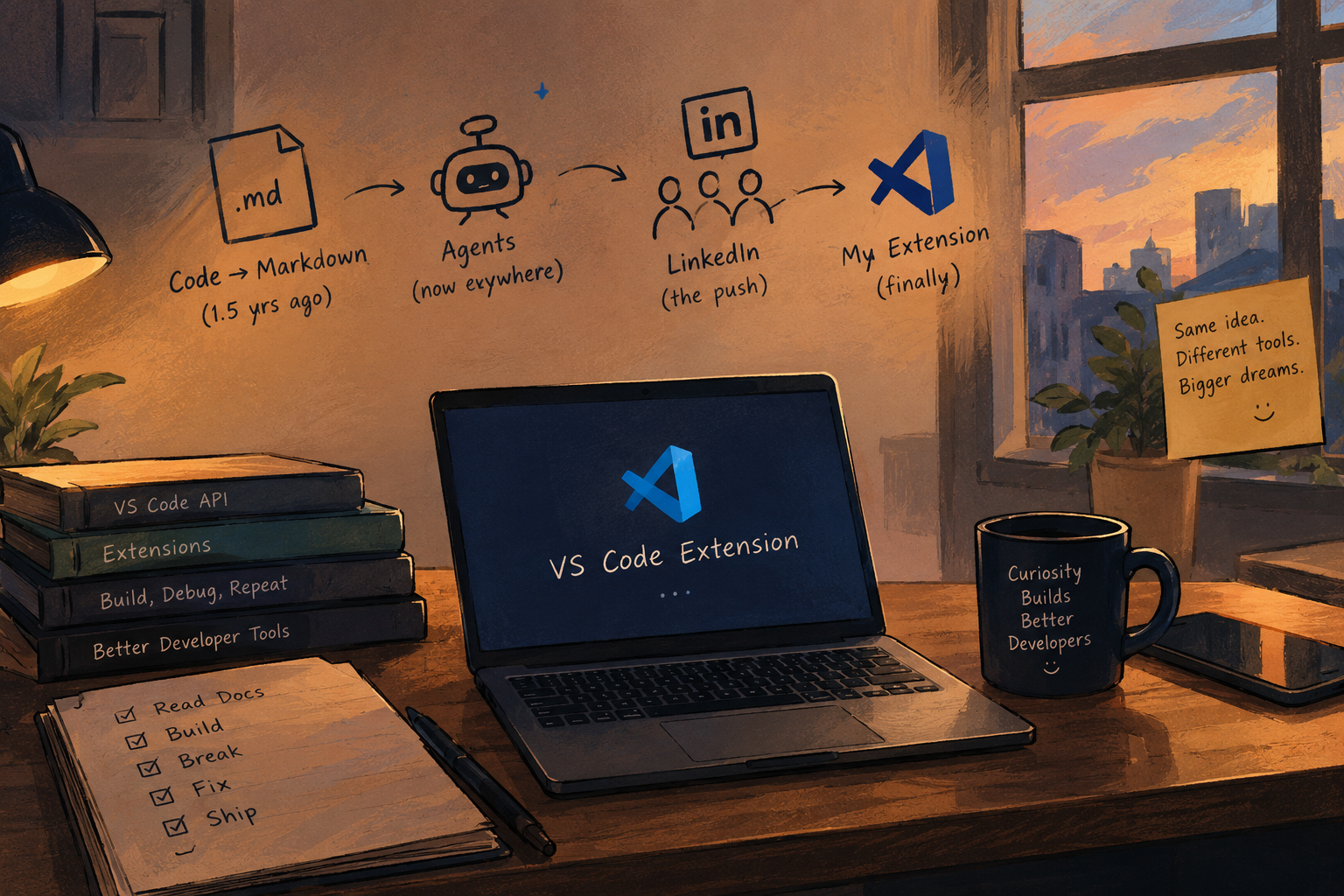
A few weeks ago, I was scrolling through LinkedIn and saw someone posting about a VS Code extension they had built. Then I saw another person who had built a Chrome extension. Then another developer had built some small developer tool and was proudly sharing it. My first thought was, “Okay, these people must be really good.” Then I actually checked their profiles. Third-year students. Fourth-year students. And I had one slightly uncomfortable thought: “Wait... if they can build extensions, why have I been treating this like something only pro-level developers do?” That thought eventually turned into a project, but honestly, the story started about 1.5 years ago.
At that time, I was working at my previous company. This was before AI agents became such a huge part of everyday development, or at least that's how it felt to me. We were asked to convert our code files into .md files so that the GitHub agent could read them, understand the project, and learn about our codebase. I didn't think much about it back then. There was a task, there were files, and there was ChatGPT. So I did what probably a lot of developers would have done. I gave each file to ChatGPT and asked it to generate a Markdown version that an AI agent could understand. Then I copied the output and pasted it into the codebase. Next file. Same thing. Copy, paste, repeat. At that time, I wasn't thinking about AI-assisted development, context engineering, or where all of this was going. It was simply another task that needed to be completed. If someone had told me back then that I would eventually write a blog about those .md files, I probably would have said, “Bro, it's just a Markdown file.”
Fast forward to 2026 and suddenly agents are everywhere. Agents understand repositories, generate code, modify files, review code, create documentation, and sometimes probably judge the way we name our variables. Looking back, those Markdown files started to make a little more sense. We were basically trying to give an AI system enough structured context to understand our codebase. I just didn't realize how important that idea would become.
Then LinkedIn came along and ruined one of my excuses. I had always assumed that building a VS Code extension was one of those things that required you to be a serious developer. You know the type: three monitors, mechanical keyboard, dark terminal, a GitHub contribution graph that looks like a mountain range, and probably some complicated Vim configuration that nobody else understands. So whenever I saw someone building an extension, my brain automatically classified it as “advanced developer stuff.” Something I'd probably do someday. Then I started noticing the profiles of the people actually building these things. Third-year students. Fourth-year students. People who were still in college and already publishing their own tools. And suddenly my excuse had a bug. I thought, “Okay, if they can build one, I should at least try.”
So I decided to build my own VS Code extension. But the motivation wasn't initially some big business idea or a revolutionary developer tool. I had a much simpler reason. I wanted to send it to my old teammates. I wanted to show up in the old company group chat and casually say, “Hey guys, remember those .md files we were creating for the GitHub agent? Anyway, I made a VS Code extension. You can use it.” That's basically how this started. Maybe that's not the most noble reason to build software, but it worked.
I started with the official VS Code documentation and went through the “Your First Extension” guide. What surprised me was how approachable it actually was. I had built up this idea in my head that extensions were some complicated thing only experienced developers could create. But once I opened the documentation, it was basically another software project with an API I hadn't worked with before. One of the first things I noticed was extension.ts. That file is basically the entry point for the extension, and in the beginning I put almost everything there. Commands? extension.ts. Logic? extension.ts. Processing? extension.ts. More logic? Still extension.ts. At one point, I think extension.ts was doing more work than I was. But it worked, and that's the dangerous stage of every project. When bad architecture still works, you keep telling yourself, “It's fine.” Then you add another feature. Still fine. Another feature. Fine. And suddenly you have a giant file that you are emotionally attached to because, well, “but it works.”
Eventually I had to clean it up. I started separating the responsibilities. Commands went into their own folders, processing logic was separated, services got their own place, and utilities moved out. The project slowly started looking like an actual maintainable project instead of one giant file that happened to run. That's probably when it started feeling like a real project to me.
Of course, I wasn't doing all of this completely on my own. I was using ChatGPT quite a lot. But I made one rule for myself: no blind copy-paste. I didn't want to ask ChatGPT to build the entire extension, paste hundreds of lines of code into my project, and then call myself a developer. Because there is a very specific kind of confidence you get from code you didn't actually write. It lasts exactly until the first error. Then you see something like TypeError: Cannot read properties of undefined and start wondering, “Who wrote this?” Technically, I did. So instead, I tried to use AI more like a coding partner. I'd ask about the VS Code API, understand the approach, generate a small piece, read it, modify it, break it, fix it, and then move on. AI can help me write the code, but I still want to understand why the code exists. That's basically my version of vibe coding.
And this is where the old .md files came back into the story. A year and a half ago, I was thinking, “Why are we converting all these code files into Markdown so an AI can understand them?” Now I'm sitting here using AI to help me build a developer tool. The tools changed. The terminology changed. The way we interact with AI changed. But the basic idea is surprisingly similar. We are still trying to make software understandable to machines, except now those machines are also helping us create the software.
The biggest thing I learned from this wasn't actually about VS Code extensions. It was about the imaginary skill barrier I had created in my own head. I've already spent years working with backend systems, APIs, databases, authentication, cloud infrastructure, deployments, and all the usual things that come with software development. But somehow I still had this mental category called “things real developers build.” VS Code extensions were sitting inside that category until I actually opened the documentation. Once I started building one, the mystery disappeared. It wasn't some secret technology reserved for elite developers. It was simply another software project with a different API, a different runtime, and a different set of problems to solve.
And that made me think about how many other things we probably avoid simply because we've never tried them. So that's how this project started. Not with a startup idea, not with a business plan, and not with some revolutionary product concept. It started because I saw a bunch of college students building extensions on LinkedIn and thought, “Okay, maybe I should stop assuming this is something only other people can do.”
Somewhere along the way, I went from “Why are we creating .md files for an AI?” to “Let me build a VS Code extension that other developers can actually use.” Maybe that's what building software in the AI era looks like. You don't need to know everything before you start. You need enough curiosity to open the documentation, enough patience to understand what the AI generated, enough stubbornness to debug it when it breaks, and enough courage to publish the thing when it finally works.
A year and a half ago, I was converting code into Markdown so an agent could understand it. Today, I'm using an agent to help me build software. Tomorrow? Who knows. Maybe I'll build an agent that builds agents, and then I'll probably have to write another blog explaining why I did that.
But for now, I have a VS Code extension. And somewhere in my old company group chat, there are probably a few people who are about to receive a very unnecessary: “Hey guys, remember me?”